
Without small modular reactors powering remote projects, Canada’s vast resources will stay in the ground
 Canadians have often spoken of their country as an energy superpower. We might also take pride in thinking of ourselves as a natural resources superpower, a mining superpower, or a critical minerals superpower.
The problem is that those labels are more aspirational than real. The possibilities are vast, but we are not yet living up to our potential.
Alberta’s first shipments of LNG across the Pacific began only in the middle of 2025. Ontario’s Ring of Fire, one of the most promising mineral sites in the world, remains undeveloped. Most of Nunavut is rich in gold, iron ore, zinc, rare earth elements, and exploration has only just begun. There are also large untapped reserves of natural gas and oil offshore the Northwest Territories and the Yukon in the Beaufort Sea.
What are the barriers to development? Harsh conditions including permafrost, extreme cold, and short seasons; the lack of roads, ports, or other infrastructure; very high logistics costs; workforce skill gaps; environmental vulnerabilities; long permitting processes and sometimes complex land claims. Those are certainly challenges. But they are arguably easier to overcome than a more fundamental challenge: energy infrastructure.
Powering remote industrial sites has historically been a massive engineering and logistical challenge. Such locations required reliable, high-output power round the clock, all week, for heavy machinery, lighting, ventilation, pumping, drilling, processing, and so on. But they are very remote from provincial electricity grids.
The main solution has always been diesel-generated electricity, often supplemented by natural gas where available. But doing this comes with significant limitations and entails major problems. Enormous volumes of fuel need to be delivered over long distances by truck, barge, ship, ice road, or even airlift in some cases.
In the most remote areas, resupply windows are extremely narrow thanks to the weather, but fuel always needs to arrive precisely when expected. Apart from the enormous expense and pollution involved, the practice is inefficient, noisy, and dangerous.
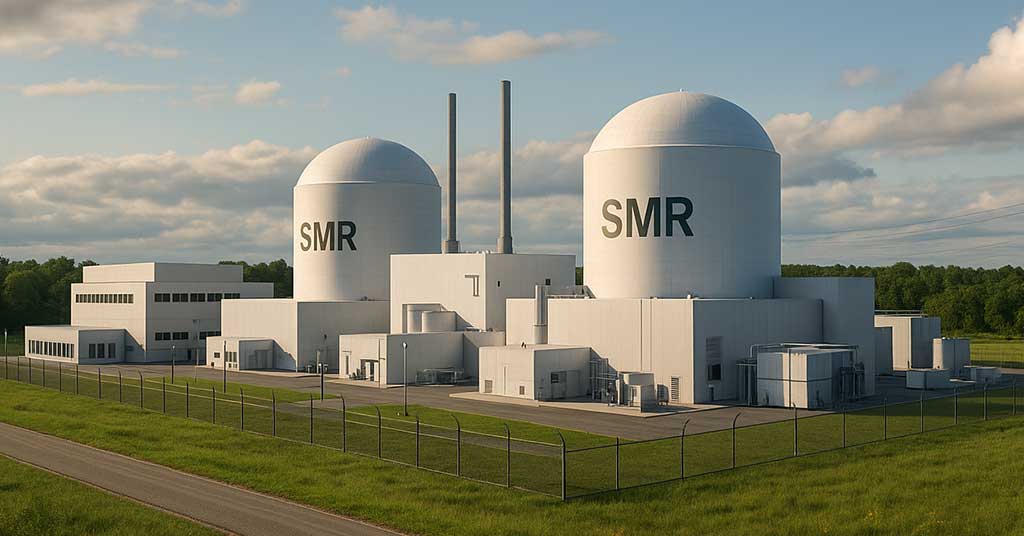
But a new solution has appeared in the form of Small Modular Reactors (SMRs). These are small nuclear reactors capable of generating five MW to 50 MW of electrical power. They are perfect for remote and even Arctic areas because they generate clean nuclear energy, but without the high cost, long construction time, and huge surface area of traditional nuclear power plants.
SMRs are compact and designed for factory assembly and site installation. They are easy to transport and their design can be altered to suit the environment. The modular approach slashes construction time and costs while also enhancing safety through passive cooling systems operating without external power and without a huge complement of specialized staff. SMRs are much safer than traditional nuclear power plants.
Another important point revolves around food in remote areas. SMRs would allow even Arctic mining communities to operate their own greenhouses and to grow their own food throughout the year.
However, nuclear energy works best running steadily at high capacity but demand for electricity for construction or mining in harsh environments can vary considerably throughout the day and over the course of the year.
This is where batteries come in. A Battery Energy Storage System (BESS) can flexibly store energy when demand is lower and discharge it whenever needed. A BESS can shift energy across hours or days, balancing fluctuations in electricity demand and preventing blackouts during extreme weather or demand spikes.
Together, smaller reactors and BESSes form a powerhouse duo: SMRs generate steady, clean power, while BESSes store surpluses for peak times, maximizing efficiency and minimizing waste. And thanks to modularity and recycling used batteries, costs continue to fall.
So far, our national conversation on energy production and resource extraction has revolved around permitting, red tape, and regulation. These are important concerns, and the government must do more to reduce such burdens. But the question of reliable power in remote areas remains vital.
The federal government announced the SMR Action Plan in 2020, and recently announced an SMR project at the Darlington Nuclear Facility in Ontario. Other small reactors have been considered elsewhere, but Darlington is expected to have the first in Canada by the end of 2030. This is welcome news, but it is a very slow start.
SMRs and BESSes will have a vital role to play in future nation-building projects and domestic prosperity. In fact, the more remote the project, the more likely it is that nuclear power will be the only viable option.
David Parry is managing partner at Malahat Battery Technologies Corp.
Explore more on Natural resources, Nuclear energy, Arctic
The views, opinions, and positions expressed by our columnists and contributors are solely their own and do not necessarily reflect those of our publication.
Troy Media empowers Canadian community news outlets by providing independent, insightful analysis and commentary. Our mission is to support local media in helping Canadians stay informed and engaged by delivering reliable content that strengthens community connections and deepens understanding across the country.

