
Threatening prosecution for refusing to complete the census might produce compliance, but it weakens the trust on which democratic government depends
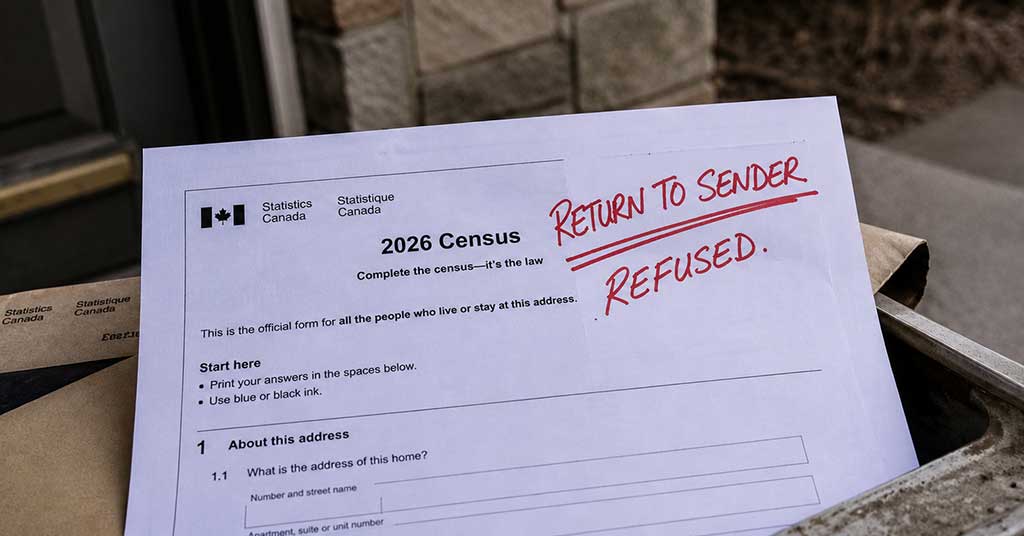
A few thousand Canadians mailed their 2026 census forms back this spring, marked “return to sender,” some with a personal word for the prime minister. Statistics Canada mailed a reminder, and a small number may eventually be referred for prosecution under the Statistics Act.
Lost in the noise about new questions on health, homelessness, and gender assignment is the older question beneath them: what does a free citizen owe a government that wishes to know him completely, and what may that government do to him if he declines to answer?
Almost no one in authority has tried to answer that question. The objection and the official reply belong to different worlds. The objection is one of consent: that the state should not compel intimate disclosure under penalty. The answer offered is one of accounting. Refuse the census, Canadians are told, and your municipality loses its per-capita share of federal money; Prince Albert, for example, says it forfeited millions after a weak count.
The funding claim is true. It is also beside the point. A question about money may outweigh a question about rights in some ledger, but it cannot refute it. The objector asked whether the thing was right and was told what it would cost.
Where argument fails, ridicule takes over. A former Alberta premier called the resisters “not smart.” A Liberal member of Parliament called them “extremely misinformed.” A federal minister announced they were doing their communities a disservice. Mockery is neither respectful engagement nor refutation. It reclassifies the objection from a claim that must be answered into a malfunction that must be managed, a reflex the COVID years made wearily familiar.
Consider the arithmetic that the fine is meant to defend. A few thousand refusals among 41 million Canadians move none of the aggregate figures the census exists to produce. The statisticians lose nothing.
What the penalty protects is not accuracy but obedience, and obedience compelled is the most expensive thing a government can buy because authority runs on trust rather than fines: on the willingness of the great majority to believe the promise of confidentiality and accept the civic case for answering.
Public trust is no longer what it was. Confidence in the federal Parliament sits near a third of Canadians; trust in the courts has fallen below half over a decade; trust in the media is lower still.
When confidence wanes, voluntary compliance weakens, and authorities increasingly resort to coercion to hold the line, further eroding trust.
The fine for an unanswered form is a small turn of that wheel. Nothing accelerates it faster than watching the state reserve its severity for the powerless.
At the same time as ordinary Canadians were warned of prosecution over a questionnaire, the Lobbying Commissioner told a parliamentary committee that she had referred more than a dozen suspected breaches of the Lobbying Act to the RCMP. She also acknowledged that the last successful prosecution under the Act occurred more than a decade ago.
Thousands of lobbyists are registered in Ottawa. The problem is not that lobbyists escape prosecution. The problem is that governments lose moral authority to compel ordinary citizens when they appear reluctant to enforce laws against the powerful.
Return to Prince Albert. A shortfall that clusters in one place is not random noise but information, and a census of all things ought to be able to read it. The hardest people to count are reliably the poor, the transient, the Indigenous, and the alienated, which is to say those with the least reason to believe the state means them well.
The useful question is not how to force them to answer, but why so many will not, and why there. Refusal is itself a finding, perhaps the most honest the whole exercise produces.
Other democracies have faced the same question without the fixation on obedience. American law makes the census mandatory, yet no one has been prosecuted for refusing since 1970. West Germans met their 1983 census with a popular revolt, and its Constitutional Court struck down the law, recognizing a constitutional right to control personal information. Germany now gathers much of its census information from existing government records. The Netherlands held its last door-to-door census in 1971 and has compiled its population statistics without a census ever since. None of these states collapsed for want of a fined citizen.
The point is not that Canada should abandon the census, which serves real purposes, but that it should stop confusing a count with a verdict. A right that protects only the popular is no right at all; it is a courtesy extended to the majority and revocable at its pleasure.
The few who hesitated this spring have not been refuted. They have been outnumbered and told that the counting was the answer. It is not. The question they raised is still waiting, and a government confident of its own legitimacy would answer it.
Dr. Marco Navarro-Génie is the Vice-President of Research and Policy at the Frontier Centre for Public Policy. An expert on radical revolutionary movements and political identity, he is a recipient of the King Charles III Coronation Medal for exemplary public service. He is the author of three books, including the 2023 release Canada’s COVID: The Story of a Pandemic Moral Panic, co-authored with Barry Cooper.
Explore more on Democracy, Liberal government, Rights and Responsibilities
The views, opinions, and positions expressed by our columnists and contributors are solely their own and do not necessarily reflect those of our publication.
Troy Media empowers Canadian community news outlets by providing independent, insightful analysis and commentary. Our mission is to support local media in helping Canadians stay informed and engaged by delivering reliable content that strengthens community connections and deepens understanding across the country.

