
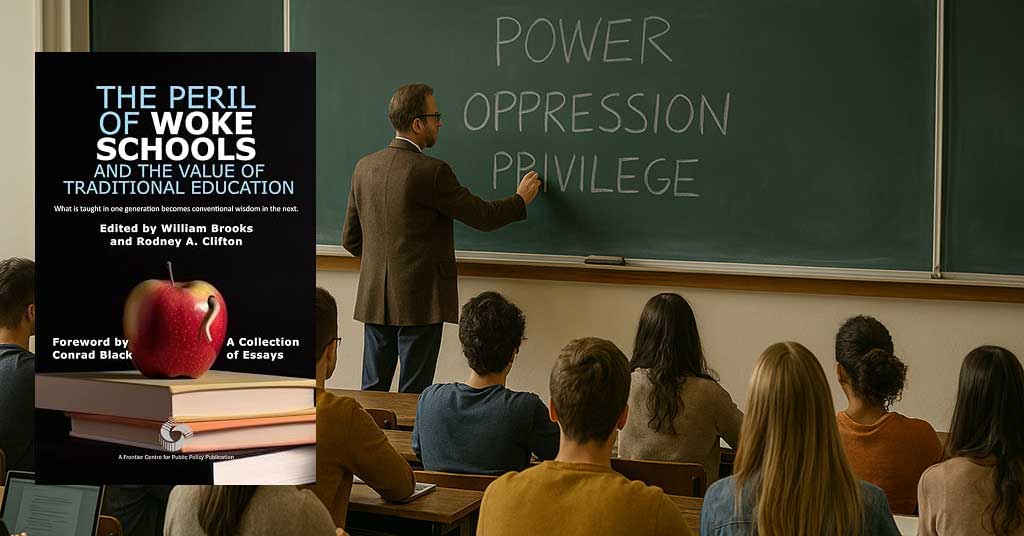
A new book argues woke ideology is weakening academic standards, reshaping curriculum and pushing traditional education aside
Title: The Peril of Woke Schools and the Value of Traditional EducationEdited by: William Brooks and Rodney A. Clifton
Publisher: Frontier Centre for Public Policy
Publication Year: 2026
(Available from Amazon)
The Frontier Centre for Public Policy, an independent Canadian public policy think tank, has entered the debate over the ideological battle reshaping Canadian schools. Its recent book argues that woke ideology has not simply changed what schools teach. It has changed what education is for.
The Peril of Woke Schools and the Value of Traditional Education is a collection of 52 essays by 18 contributors examining contemporary educational practices and calling for a return to traditional principles centred on knowledge, critical inquiry and intellectual diversity. The essays are framed by a useful introduction and concluding remarks by co-editors William Brooks and Rodney Clifton. Canadian scholar and businessman Conrad Black also endorses the collection in an insightful foreword.
The book covers a wide range of topics, from influential philosophers of progressive education like John Dewey and Paulo Freire to parents’ growing concerns about the effects of 21st-century woke education on their own children.
From the so-called woke perspective, there are no shared universal truths. In fact, particular groups of people are encouraged to construct their own truths. Several contributors challenge the radical curriculum that was allegedly created to inspire revolutionary action by “oppressed people” and shift the balance of formational power toward educators who have supposedly been suppressed by traditionalists.
That represents a fundamental break with the traditional purpose of education. Instead of passing on inherited knowledge and teaching students to think critically about it, education has increasingly become a vehicle for challenging established ideas and advancing particular ideological perspectives.
This clash between woke culture and traditional educational values illustrates something akin to a Kuhnian paradigm shift. As in Kuhn’s account of scientific revolutions, an established framework loses authority while adherents of a rival paradigm present their assumptions as the new orthodoxy. Traditionalists are increasingly cast as out-of-touch has-beens whose ideas must give way to a supposedly more enlightened philosophy.
The book’s editors note that traditional teachers earned university degrees in particular disciplines, followed by some form of teacher certification. More recent entrants to the teaching profession, especially in the humanities, are more likely to have a general degree in education. The book argues that postmodern cultural Marxist philosophy has become exceptionally dominant in faculties of education and now serves as a basis for both teacher training and classroom practices.
Traditional educators have consequently come to view faculties of education as a contemporary bastion of the woke culture they oppose. Contributors argue that this shift away from traditional education has resulted in a decline in educational standards and student performance on international tests. Frontier’s book provides examples of unproductive teaching methods and declining curriculum standards that the authors contend have had harmful effects on students and schools.
Contributors to the collection offer many examples of how proponents of woke schools use the uncontested power of teachers’ unions, school boards and faculties of education to oppress those who want to keep or restore more classical approaches to education. In fact, some essays expose incidents in which students, teachers and school board trustees have been suspended or fired for promoting a traditional curriculum and teaching methods.
The book’s argument is unmistakable: the Marxists are winning the education war, and it is hard to disagree. So much for academic freedom and open debate.
One Ontario case shows just how far things have gone. The outlandish female costume worn by a male teacher who chose to dress as a woman while teaching a woodworking course at an Ontario high school was defended by a teachers’ union that saw no problem with the pendulous prosthetic breasts he wore to class and the behaviour he modelled for his adolescent students. Parents, of course, were shocked by the teacher’s deportment.
The same struggle extends to alternatives to the prevailing public education model. Some essays point out the fierce opposition to charter and other forms of independent schools in many provinces and territories. In Alberta, charter schools are autonomous non-profit public schools that follow the provincial curriculum.
Independent schools are seen as elitist, even though several have won awards based on student academic achievement. Unfortunately, only Alberta has allowed taxpayer-funded charter schools to be established. In other provinces and territories, charter schools have not been set up because woke apparatchiks in provincial and territorial governments and teachers’ unions strenuously object to funding them.
With more than 50 essays, the collection inevitably approaches some of the same issues from different directions, and readers who reject its underlying critique of progressive education are unlikely to be persuaded by every argument. Nor does every essay need to be equally persuasive for the book’s larger case to succeed.
Taken as a whole, the collection makes a convincing argument that the debate over woke schools is ultimately not just about curriculum, pronouns, teaching methods or individual controversies. It is about the purpose of education and whether schools should transmit accumulated knowledge and teach students to think critically about it or become instruments for transforming society.
The essays in The Peril of Woke Schools give traditionalists evidence and arguments they can use to get back into the important debate over the quality of our schools. Parents concerned about their children’s education will find this book particularly valuable, as will traditional teachers, school administrators and school board trustees.
James Dean Ph.D. is a Senior Fellow (Retired), St. John’s College and Professor of Economics (Retired) in the University of Manitoba. He taught for 42 years and specialized in public finance. He served the university in various administrative positions, including as Executive Director of International Relations. He has a keen interest in education policies.
Explore more on Wokeism, Education reform, Parental rights, Coercive progressivism
The views, opinions, and positions expressed by our columnists and contributors are solely their own and do not necessarily reflect those of our publication.
Troy Media empowers Canadian community news outlets by providing independent, insightful analysis and commentary. Our mission is to support local media in helping Canadians stay informed and engaged by delivering reliable content that strengthens community connections and deepens understanding across the country.

