
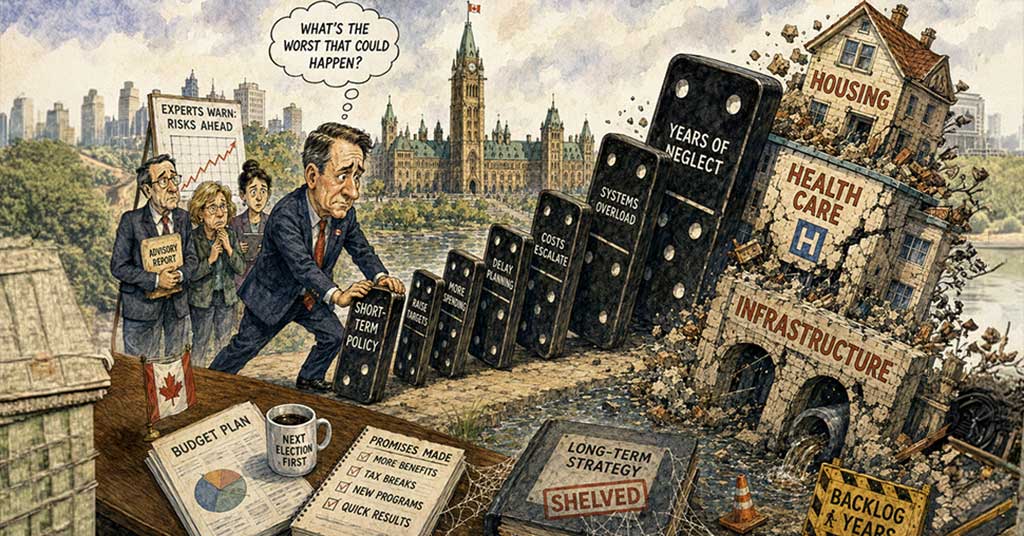
Politicians love the quick win, but it’s Canadians who pay the price for the consequences
Governments rarely lack for solutions. The harder question is what those solutions set in motion. Too often, solving one issue creates new pressures somewhere else.
Government itself makes that difficult to anticipate. Immigration, housing, health care, public finances and trade may be handled by different departments, but they don’t operate independently. A decision made in one can quickly affect the others.
Then there is politics. Governments are rewarded for delivering visible results within an election cycle. The consequences can take years to emerge, sometimes in another department or under another government. By then, the people who made the original decision may have moved on.
Immigration is a good example. Canada needs newcomers. Our population is ageing, Canadians are having fewer children and employers need workers. Statistics Canada’s latest projections show that migration will remain the main source of Canada’s population growth.
But a growing population needs somewhere to live. It needs doctors, schools, transportation and infrastructure, as well as opportunities for newcomers to put their skills to work. If those things don’t keep pace, solving a labour or demographic problem can create problems elsewhere.
So while Canada will need more people, we also need to be able to support them. Shouldn’t immigration targets reflect our ability to house, employ and provide services for a growing population?
If they don’t, we can meet the target and still end up with a poor overall result. Immigration officials may have done exactly what was asked of them while housing, health care and infrastructure struggle to keep up.
Debt presents the same problem over a much longer period. Borrowing can make sense when governments invest in productive infrastructure or respond to emergencies. But decisions made today can limit the choices available tomorrow.
The stakes become higher as Canada’s population ages. Statistics Canada projects the proportion of Canadians aged 65 and older will rise from 19.5 per cent in 2025 to somewhere between 22.6 and 32.5 per cent by 2075. The federal government’s Spring Economic Update forecasts that elderly benefits will reach $89.3 billion in 2026-27, and public debt charges will reach $58.7 billion. As retirees make up a growing share of the population, pressure on health care, pensions and other public services is likely to increase.
So what choices are we leaving future governments?
No single spending decision is necessarily the problem. Many can be defended. The concern is what happens when they add up. It isn’t enough to ask whether we can afford a new commitment in the next budget. We also need to ask whether we will still be able to afford it as the population ages and fewer workers are available to support public services.
Trade offers another example. Canada spent decades integrating its economy with the United States for good reason. The Americans are our neighbours and an enormous market, and integrated supply chains have made companies on both sides of the border more efficient. In 2025, 71.7 per cent of Canada’s merchandise exports went to the U.S.
For years, that efficiency looked like strength. Now we are being reminded that efficiency and resilience are not the same thing. A resilient economy must be able to withstand tariffs, trade disruptions or political decisions by other countries without suffering serious economic damage.
Our close relationship with the U.S. made us more efficient, but it also made us more dependent. That doesn’t mean integration was a mistake. Canada should continue pursuing access to the U.S. market. But shouldn’t we be paying as much attention to resilience as we do to efficiency?
I have seen this tension throughout my career working with technological change. Innovation reshapes businesses, industries and behaviour, often in unexpected ways. One lesson appears repeatedly: change one part of a complex system and the effects rarely stop there. Government policy is no different.
That’s why governments need to look further ahead. What will today’s immigration decision mean for housing five years from now? What will today’s spending commitment mean as the population ages? How vulnerable will today’s trade strategy leave us if another country changes the rules?
We will never eliminate unintended consequences. No government can predict everything. But meeting a target, funding a program, or delivering a promised result isn’t enough to claim success if the decision creates greater pressure elsewhere.
Good policy requires asking one more question before acting: What happens next?
Dr. Perry Kinkaide is a visionary leader and change agent. Since retiring in 2001, he has served as an advisor and director for various organizations and founded the Alberta Council of Technologies Society in 2005. Previously, he held leadership roles at KPMG Consulting and the Alberta Government. He holds a BA from Colgate University and an MSc and PhD in Brain Research from the University of Alberta.
Explore more on Federal politics, Immigration, Federal debt and deficit, Canadian economy
The views, opinions, and positions expressed by our columnists and contributors are solely their own and do not necessarily reflect those of our publication.
Troy Media empowers Canadian community news outlets by providing independent, insightful analysis and commentary. Our mission is to support local media in helping Canadians stay informed and engaged by delivering reliable content that strengthens community connections and deepens understanding across the country.

